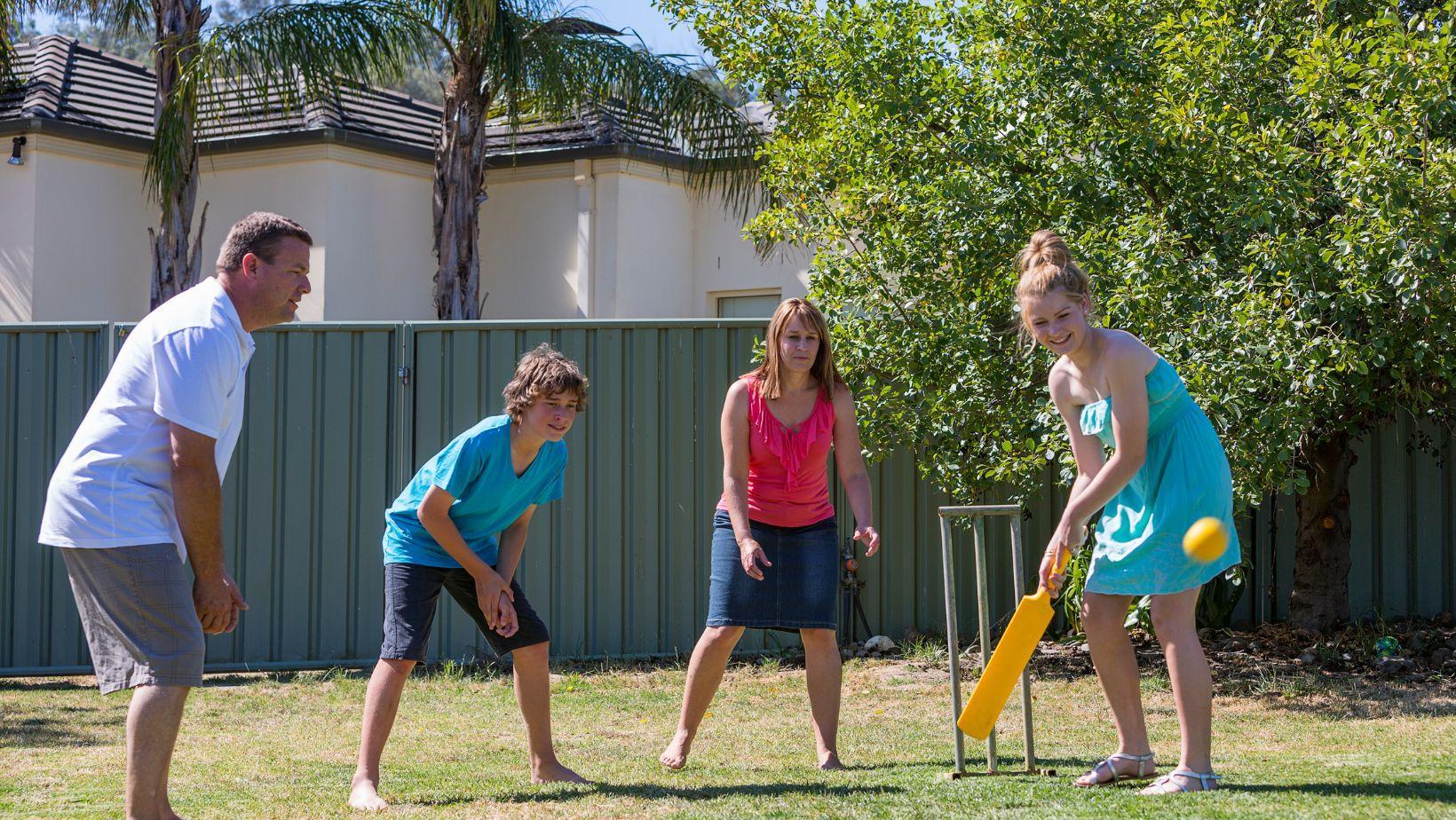
Backyard cricket works best when everyone agrees on a few simple rules before the first ball is bowled. All that is essential is a bat, a ball and something to serve as a wicket, while the rest can be adapted to the available space and the ages of the players. A tennis ball, short pitch and clear boundaries make the game safer and easier for family members and friends to enjoy together.
Table of Contents
ToggleStart with a space that suits the group
Backyard cricket can be played in a garden, driveway, park, beach or quiet open area. The pitch does not need to resemble a full cricket ground; it only needs to be reasonably flat and leave enough room for the batter, bowler and fielders. A pitch of roughly 10 to 30 metres can work, with the actual length decided by the size of the space and the ability of the players.
Before play begins, identify anything that should not be hit. Windows, parked vehicles, flowerbeds, neighbouring properties and fragile outdoor items should be treated as out of bounds. Mark a simple boundary with cones, shoes, bags, chalk or naturally visible points such as a fence line. Deciding this early avoids arguments after a powerful shot.
Choose safe equipment
A tennis ball is a practical choice for most home games. It is generally less likely than a leather cricket ball to cause injury or property damage, and it is easier for younger or inexperienced players to hit. Tennis balls also bounce more at low speeds, which can make bowling and batting more lively on grass, concrete or packed ground.
A proper cricket bat is useful, but backyard cricket has always allowed improvisation. The important point is that the bat can be held securely and used safely. For wickets, players can use stumps, a chair, a bin, a cardboard box, sticks or even a marked area on a wall. If the group uses a wall as a wicket, clearly define the target area before bowling starts.
Pick a format that gets everyone involved
A standard two-team game is ideal when there are enough players. Divide players into two balanced sides, decide who bats first with a coin toss or bat flip, and give each team an agreed number of overs or wickets. The side with the higher total wins. This structure works well when people want a recognisable version of cricket without the demands of a full match.
For a smaller gathering, a batter-versus-everyone format is usually more practical. One player bats while everyone else fields and bowls in turns. Each batter can face a set number of balls, be dismissed once, or retire after reaching a chosen score. This keeps the game moving and prevents a confident batter from holding the bat for too long.
|
Group size or setting |
Useful format |
Simple approach |
|
Three to five players |
Individual turns |
Each player bats until out or reaches a score limit |
|
Six or more players |
Two teams |
Set a fixed number of overs per side |
|
Mixed-age family group |
Retire-at-score |
Each batter retires after an agreed total |
|
Limited time |
Quick match |
Give every batter a fixed number of balls |
A set score limit is especially helpful in a family game. A batter may retire at 10, 20 or another number agreed by the group, then return only after everyone else has batted if time allows. This rule shares opportunities fairly and gives newer players a chance to face more than one delivery.
Core backyard cricket rules to agree before play
The most popular backyard rules are designed to reduce disputes and encourage fun rather than reproduce every Law of cricket. A good starting rule is “no ducks”, meaning a batter cannot be dismissed before scoring a run. Another version is the first-ball rule, under which a player cannot be out from the first delivery they face. It gives every player a moment to settle in.
“No LBW” is another useful choice. Leg-before-wicket decisions can be difficult even with umpires, and family games are normally self-officiated. Removing LBW makes the contest simpler. Batters can still be bowled, caught, run out or stumped if those dismissals suit the group’s setup.
For people who enjoy following professional fixtures as well as playing at home, a Cricket Match Prediction can be a talking point before a family game, but backyard contests are at their best when the local conditions and agreed rules decide the outcome.
One hand, one bounce
“One hand, one bounce” is a classic informal rule. If the ball bounces once after being hit, a fielder may still dismiss the batter by catching it cleanly with one hand. This adds interest in tight spaces where the ball often lands before reaching a fielder and gives younger players more catching chances.
The group should define exactly what counts. For example, decide whether the ball may bounce off grass only, or whether a rebound from a wall, fence or roof can also lead to a catch. A clear version might be: “One bounce from the ground is allowed, but the catch must be clean and taken with one hand.” Keeping the wording short makes it easier to remember.
Six and out
“Six and out” is particularly useful where a ball travelling over a fence would be difficult to retrieve or might enter a neighbour’s property. Under this rule, the batter receives six runs for the shot but is also out and is expected to collect the ball. The rule rewards striking the ball while discouraging repeated attempts to hit it out of the playing area.
It can also apply to other protected objects. A group might decide that a shot hitting a car, window or shed on the full is six and out, even if no damage occurs. For younger children, it may be better to use a softer version: the shot counts as a dead ball, and the batter simply loses no wicket. Safety should always take priority over a dramatic dismissal.
Make scoring simple
The easiest scoring system is to use marked creases at either end of the pitch. Batters score one run by completing a full run between them. Two players can bat together, or a lone batter can run between marked lines after each shot. If the ball reaches the boundary along the ground, award four runs; if it reaches or crosses the boundary on the full, award six, unless the group has chosen six and out.
In a cramped area, players can remove running altogether. Batters score only through boundaries, such as four runs for hitting a designated fence or passing a marked line. This is useful on hot days, for very young children, or when participants do not want to sprint between wickets. It also means run-outs can be left out of the game.
“Tip and run” is another energetic alternative. Once the bat makes contact with the ball, the batter must run. This prevents defensive blocking and encourages fielders to stay alert. It is best suited to players who are comfortable running and to a space where the two ends of the pitch can be marked clearly.
Bowling, fielding and wicketkeeping
Agree whether bowling will be underarm, overarm or a mixture. Underarm bowling is often easier for children and beginners, while overarm bowling can make the game feel closer to formal cricket. The bowler should deliver from behind an agreed crease, which may be a chalk line, crack in the driveway, shoe or cone.
With only a few players, an automatic wicketkeeper can solve the problem of having no one behind the stumps. A bin, wall, garage door or other chosen object can act as an “auto wickie”. If the ball hits that target directly without bouncing, the batter is out. Some groups also allow a thin edge to the wicket target to count as a catch, but this should be stated before the innings begins.
Run-outs can be adjusted to suit the wicket. If there are stumps, the fielding side can break them with the ball while the batter is out of the crease. If the wicket is a shoe, cone or marked point, a direct hit can be enough. Another option is to allow a fielder holding the ball to touch the wicket while the runner is short of the crease.
Keep the game fair across ages
Mixed-age games are more enjoyable when rules account for different abilities. Younger players may receive a first-ball exemption, a shorter bowling distance or a larger wicket target. Adults can bowl underarm, use their weaker hand for catching, or retire at a lower score to prevent one-sided innings. These adjustments are not shortcuts; they help every participant contribute.
Let players settle disagreements quickly. A simple principle works well: if nobody is certain, the decision goes in favour of the batter or the ball is replayed. The aim is to avoid long debates that interrupt the game. One adult or neutral player can also act as an umpire for close catches and run-outs, especially when children are playing.
End on a clear and friendly note
Backyard cricket does not need a fixed match length. The game can end after the agreed overs, when every player has batted, when a target is reached or when time runs out. If the ball is lost and no replacement is available, that may be the natural end of play. A short final score check and a handshake keep the result clear.
The best backyard cricket rules are the ones that fit the available space, protect people and property, and give every player a fair turn. Keep the format simple, state the key dismissals before the opening ball, and allow the game to remain flexible. That combination turns an ordinary garden or driveway into a memorable cricket ground.